
Changing Climate, Not Climate Change II
Eventually every civilization finds out what is 'sustainable'.

Moving on to Part II of my travelogue from 2023. Again, on rereading I wouldn’t change much although the trends and questions are even more obvious.
Crossing Planetary Boundaries
Our industrial economy has within the space of 150 years enabled us to design systems which shield humans from weather and terrain. Ironically research on the earths ‘Blue Zones’ geographies (which contain greater percentages of centenarians) suggest that expending human energy seems a key contributor to living longer. Today we ignore how remarkable efficient our own bodies especially when coupled with simple machines – solutions that that sufficed to build the Roman Empire, ancient Egypt and many others for millennia. Continuing to insulate humans from nature and exertion embeds behaviours that we will need to reverse as our planetary boundaries are tested. Recent scientific insights suggest that in several key areas boundaries which have provided a safe ground for humans throughout the Holocene have already been exceeded (table 1)[1]. Our ancestors would no doubt scratch their heads and wonder on our choices.
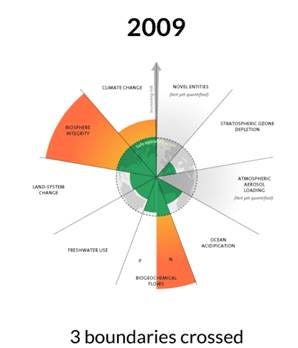
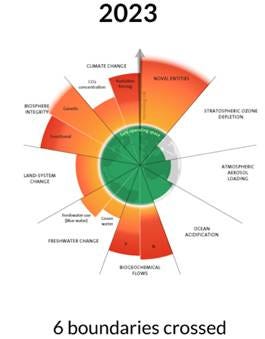
In an evolutionary context our breaching of natural boundaries has created what scientists refer to as the Anthropocene - a new geological era distinct from the Holocene which has provided the stable environment in which all prior civilizations developed and eventually collapsed. If this era is adopted officially (currently being confirmed by stratigraphic evidence) its beginnings was likely in the 1800’s with the advent of industrialization. This would be the first human defined geological era - entailing that culture is changing nature not the other way around. For the previous 280,000 years homo sapiens since the emergence of homo sapiens we shared the planet with other hominid species who for one reason or another experienced extinction – despite similar cognitive and physical attributes. A sustainable path would be to maintain the natural boundaries provided by the Holocene epoch as long as possible - to do otherwise is a one way bet that we can control our environment or perhaps live in a cognitive metaverse devoid of the need for food and water.
From a purely financial perspective, rapid change in climate ultimately limits choice. Ski properties in the Alps at lower elevations are already losing value (similar to those areas globally prone to fires and flooding as insurance companies begin to back away from the risks). Heat waves were forcing city dwellers into the mountains for their holidays, yet these regions lack AC and daytime temperatures can reach 35-38 degrees. Why not convert the region to AC? Cost is clearly a factor but the electricity would need to come from the hydroelectric plants in the region - which again rely on steady glacial flows in the face of increasingly unpredictable rains and snowpack. Unfortunately, new nuclear plants located further down in the valley will also need the same river flows for cooling – one reason the French plants were shut down last summer.
By the time I started the Haute Route in Megeve I expected heat. Catching the perfect cool week was clearly not going to happen. However, I wasn’t prepared for the 38-degree days while cycling 3000m of elevation per day. The event started with over 400 participants and ended with 290 completing. Very significant attrition given the level of entrants. Each day I thought of the changes of finishing and then doing it again the next day. The combination of heat, distance and elevation combined strangely with my heart rate depressed despite the high effort level. Yet the views from peaks as high as 2700m were awe inspiring and tremendously humbling. Putting oneself at the mercy of the elements is perhaps the most direct way to understand natures beauty, ones’ insignificance, and the ability of the human body to adapt. All this we need to relearn to adjust our relationship with nature.
Rethinking Indefinite Growth Amid Natural Limitations
Underlying all the talk of sustainability within finance is the uncomfortable truth that is physically impossible to grow at the rate of the last 50 years indefinitely. The energy required to support perpetual economic growth is only available for perhaps another few hundred years unless we experience a miraculous decoupling not yet imagined.[2] Energy use prior to the industrial revolution was low enough to be sustained indefinitely or at least for a very long time. Pre agricultural societies that defined most of human existence were sustainable if only because they were relatively small and mobile. This is not a cry for a revisit the mythical ‘good old days’ but to a modern awareness of natural limitations and context.